Metrovick 950 - an early computer using just 230 transistors

From the mid-50s, a less performant but more reliable machine based on the Manchester Mark 1 - the Metrovick 950, from Metropolitan-Vickers, part of AEI (in the UK). Some half dozen were made, and two were sold. There’s a personal account of the machine in the Computer Conservation Society’s magazine, Resurrection, from which the photo below is taken:
http://www.cs.man.ac.uk/CCS/res/res43.htm#f
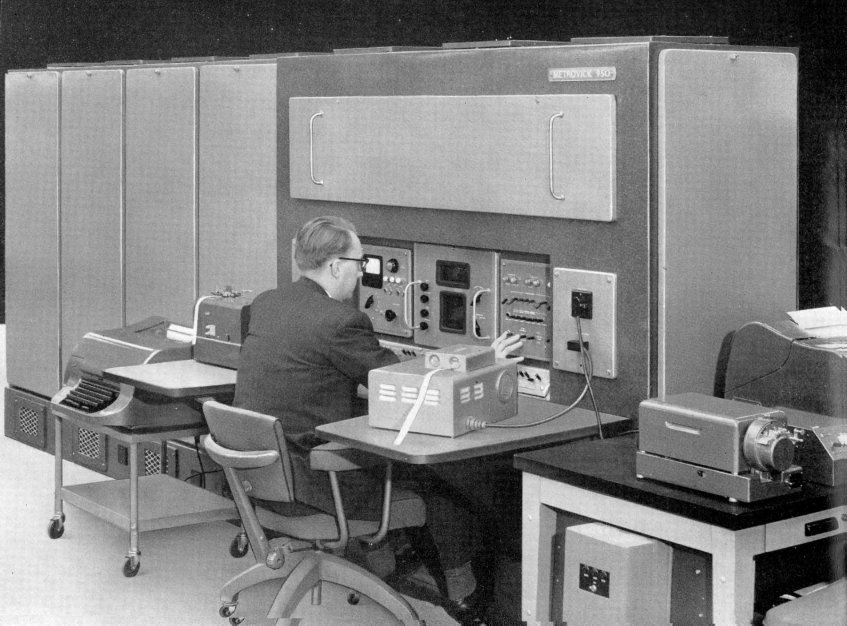
I will start by telling you how I got involved with computers and, tied in to this, why Metrovick/AEI got involved. I will go on to describe the development of the Metrovick 950 followed by the AEI 1010. Finally, I will describe a particular 1010 installation.

via this Q&A:

See also

3 Likes

I didn’t know about this one - thanks for sharing!

2 Likes

It turns out there’s an emulator, in Python, written by Nina Kalinina. Here’s a lunar lander program:

src/target $ make 007_lander
python3 ../host/asm.py -i 007_lander.asm -o 007_lander.ram -m 007_lander.map
python3 ../host/emu.py -r 007_lander.ram -m 007_lander.map
MV950 is ready. Press Enter to perform a single step, or enter a command.
===  A: 0 B: [0, 0, 0, 0, 0, 0, 0, 0]
===  I: 0x000000a4 [FD:0 BD:0 S1:0 S2:164]       CLR &0 0x0 INTRO
> g

Entering interactive mode. Press Ctrl+C to return to the shell


LUNAR LANDER

TIME ALT VELOC FUEL THRST
0 1000 50 150 0
0-30? 20

TIME ALT VELOC FUEL THRST
1 958 35 130 20
0-30?

Here’s the repo:

And a couple of docs from it (comments by Nina)

2 Likes