The earlier Native CP/M for the 6502 topic introduced David Given’s CP/M-65 project and mentioned its BBC Micro and C64 ports. I wanted to see how it would behave on a small physical KIM-1-compatible machine.
I now have CP/M-65 booting on a physical PAL-2, using an SD card module wired directly to the user RIOT. No interface board was needed, just the SD module and a few jumper wires.
My first problem sent me in the wrong direction for quite a while. The signal on PA3 only rose to about 2 V instead of the expected 5 V, so I assumed that I had made a soldering mistake or created a leakage path somewhere on the PAL-2.
The cause was a bad 6532 RIOT supplied with the kit. The chip otherwise appeared to work, but that one output produced only about 2 V for a logical high. Replacing it fixed the level, although this turned out not to be the reason CP/M-65 would not boot.
The next mistake was mine. I had connected the SD module to the PA pins of the RIOT used by the keyboard. It must be connected to port A of the user RIOT, mapped at $1700:
SD CS    -> PA4
SD SCK   -> PA3
SD MOSI  -> PA2
SD MISO  -> PA1
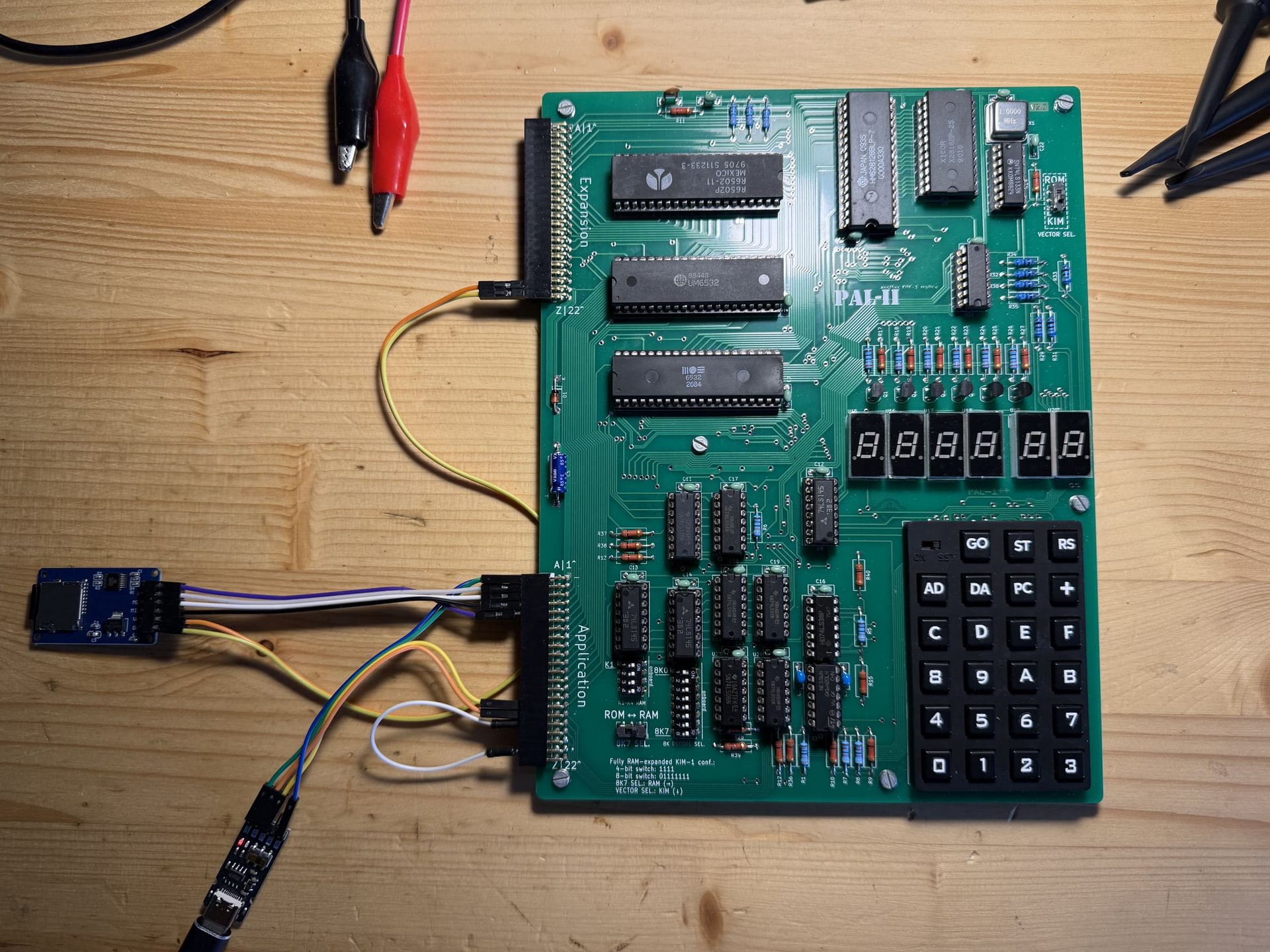
PAL-2 with the SD card module connected directly to the user RIOT using jumper wires.
Correcting the wiring was still not enough. The stock CP/M-65 SD loader did not get through initialization with my card. The card returns R1 $00 for CMD8, while the original loader expects $01 and stops with:
Abnormal termination. Error Code: 00
The card also checks the CRC of every command even in SPI mode. I asked Claude to help me inspect and patch the loader. The modified loader now:
- accepts R1
$00or$01after CMD8 and CMD55; - sends valid CRCs for CMD55 and ACMD41 (
$65and$77); - sends CMD59 after initialization to disable CRC checking, so the unchanged BIOS can continue using its dummy CRC values for sector reads and writes.
At the end I was mostly watching the signals on the oscilloscope while Claude worked through the SD initialization code via the PAL-2. This was an oddly satisfying way to debug a 6502 machine.
The patched loader is loaded at $0200 and started from the monitor with:
0200 G
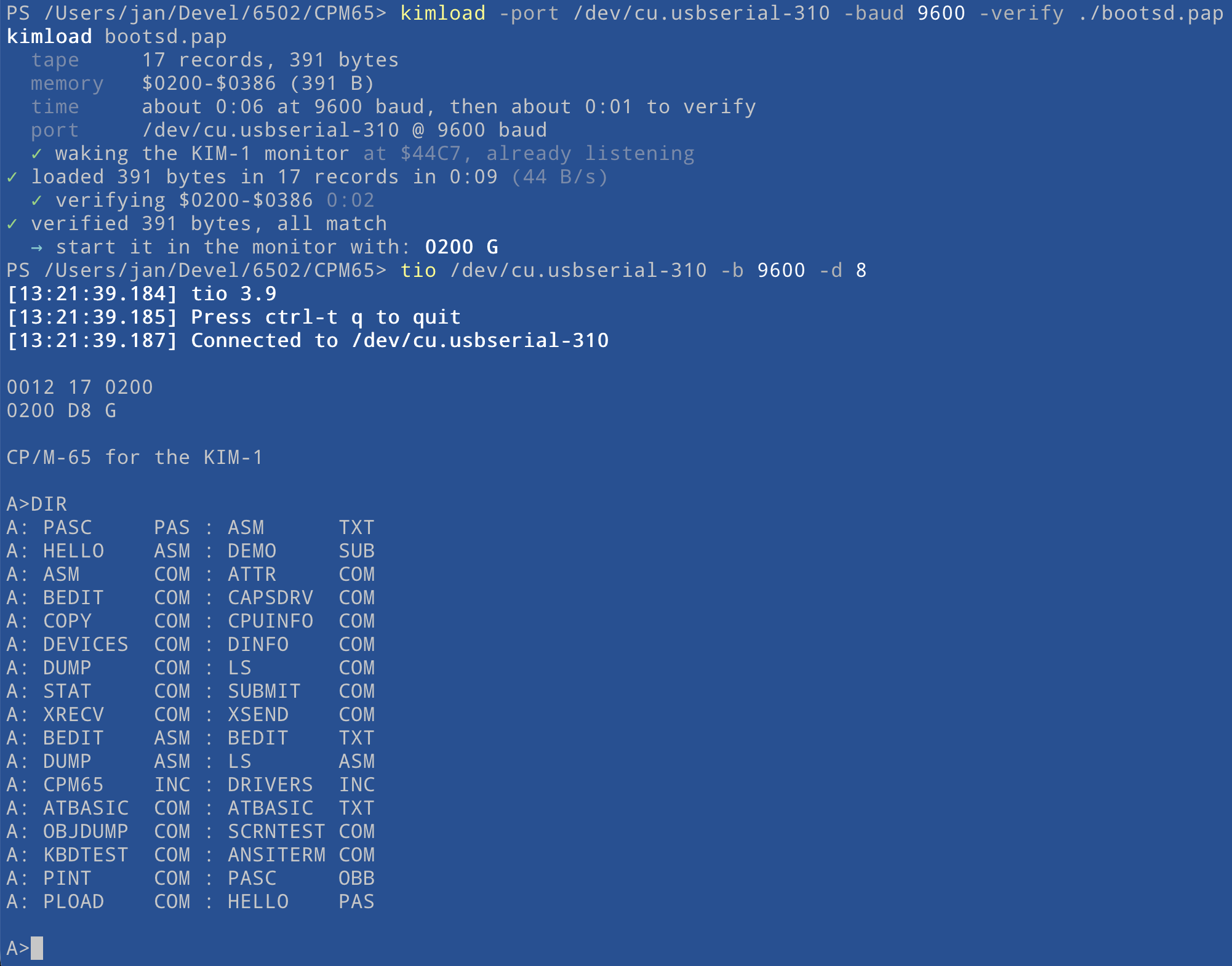
The patched loader was transferred and verified at 9600 baud; CP/M-65 then booted and displayed the contents of drive A.
The result is a working CP/M-65 system on a physical PAL-2 with a directly connected SD module.
I have put the patched source, ready-to-load binaries, SD image, diagnostic programs, wiring details and startup procedure on GitHub:
The full debugging story is here:
My PAL-2/KIM-1 project log, including the earlier stages of the build, is here:
Has anyone else tried CP/M-65 on physical KIM-1-compatible hardware? I would be interested to know whether other modern SD cards show the same CMD8 response or CRC behaviour.