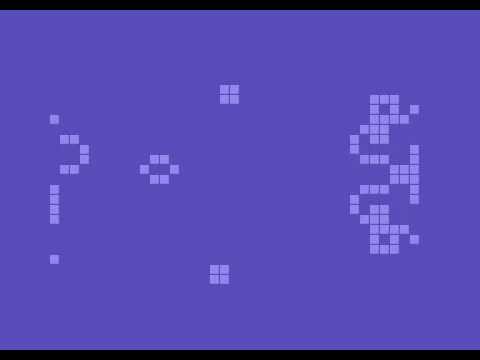
I don’t know where I got it, but I remember having access to a Life program for the PET written in 6502.
It was basically a hex dump as I recall. And it was not a short one.
It’s notable because I typed the thing in twice, once with a friend to help ensure that we got it right, but in the end it never worked. It never did anything. And we had no idea what we did wrong.
I guess, this was probably due to lots of bit shifting. Conway’s Game of Life is rather demanding on memory for early machines, if you do it just by one cell = one byte. (E.g., on a PET in best block graphics resolution, this would be 8,000 bytes to store two fields of 50 x 80, and there are just 8K of memory guaranteed). So bit-vectors to the rescue. But this is also, where the 6502’s limited amount of registers bites…
P.S.: On second thought, you could also store the two fields encoded as, say, 1 and 2 in a single byte vector, which amounts just to 4K, which is pretty doable and no intermediate storing of shifted values required.